Moving into Adaptive Philanthropy

Recently there has been much discussion in the blogging and print world about Kiva.  I am not going to weigh in on this debate because it just speaks back to my earlier blogs about questions to ask before making a donation.

What I do want to discuss is how the space of philanthropy is adapting to change, whether it is market-forces with the upsurge of social enterprises or the economy.  This is what it has to do with Kiva.  The Kiva model was a fore-runner for the current way of giving, it brought micro-finance/ micro-credit to the capitalist mentality to every-day AND large-scale philanthropists.

We are at a new evolutionary junction in charitable investments.

This year we are celebrating the 150th Anniversary of the Origin of Species - Darwin's book on evolution.  This year we are also seeing a significant shift in the attitudes and way people are donating.  There is a collective consciousness awakening on the impact that our charitable actions are having.  This evolution is driving individuals, businesses, charities and hopefully soon - government to look at the charitable system that we have set up and start fixing it.

What's wrong with the sector? 

  1. Communication style: A few months ago Dexterity Consulting conducted an online survey of donor's experiences with the charities that they support.  Besides not being thanked enough, the top "thing" they would change is the information that is being communicated.  Transparency is one thing, but if the charities are being transparent about something that is of little relevance to the donor then are they really being transparent?  If a donor doesn't articulate what his/her expectations are can they be upset with the charity for reporting back on this item of little relevance? 
  2. Hand-out mentality: This is not just in the developing world.  Multi-year financing vs. lump-sum donations is a question I am asked quite a bit, especially when donations are considered as part of an overall tax planning strategy.  Every year I get solicited by the same charities through direct mail (very little comes over the phone). Every year the message is relatively the same in these mailings.  Our core agencies, whether local, national or international, have become so dependent on a revenue stream that is built on the, "Please sir... can I have some more," mentality it is no wonder that they are living hand-to-mouth and in some instances, at crisis funding on an annual basis.  What if we were to start looking at a revenue stream that was not based so much on the generosity of individuals to get beyond year one, and started looking at revenue models that went beyond the traditional fundraising campaign (annual, major gifts, planned gifts, etc.)? Would the market place pay for services knowing that this isn't just a cost recovery program, but an investment back into the agency to ensure that the necessary services provided by the organization are met.  Some examples of this are the Green Calgary Eco-Store, or Habitat for Humanity's Re-Store.
  3. Silver Bullet Solution: There is a conversation between the Give Well blog and Tactical Philanthropy blog on the best way to donate (in this case it was between Kiva and DonorsChoose).  I would argue that the need to choose between one or the other is irrelevant.  Rather, you should be looking at the long-term vision of what you are trying to accomplish with your charitable dollars.  This also means recognizing that what you want to accomplish might not be achieved in your lifetime.  For example, the eradication of poverty requires multiple approaches.  Why choose one agency to address this very complex problem?

A solution - moving in Adaptive Philanthropic Space:

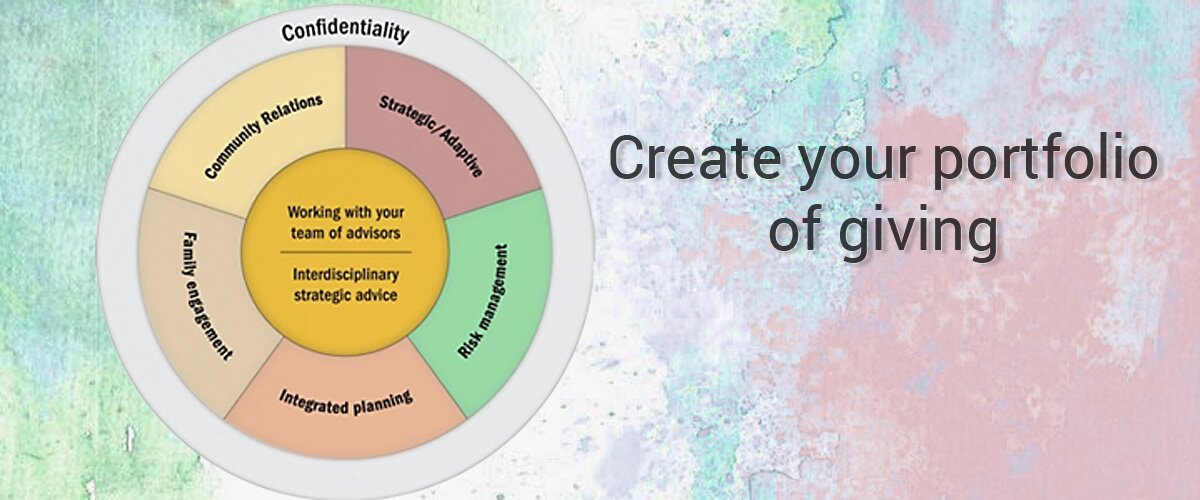
  1. Managing the Complexity: Create a mutual fund of charities that attacks the issue from several angles enabling you to diversify your approach, provide you with the data to measure impact in the long run through comparison of multiple variables.  Just as you would diversify your investment portfolio to manage risk, you can diversify your charity portfolio to direct your social vision.  The beauty of a mutual fund approach to philanthropy is that it can be applied to any area: education (scholarships, classroom materials, teacher quality, access to technology, access to external opportunities, etc.), with the arts (scholarships for art students, festivals showcasing a type of work, etc.), homelessness (shelters, job-placement, mental health, immigration support, re-training, veteran supports, etc.).  My guess is that you will see that what you think is a solution to your social vision is also a solution to another social issue. 
  2. Managing Turf: A residual comment that came out of the earlier mentioned survey on donor experiences was one made by charities about their number one concern regarding donor management... This concern was the same across the board - worried that donors would "jump ship" to the competition if they new that there was an organization out there doing the same (or similar) work.  I thought this was interesting so I asked a few of my clients during our meetings what they thought of this.  Their reaction was one of shaking heads and re-articulating their frustration with the system.  First of all, most people know that there is an inordinate amount of duplication in the sector; these individuals that I asked were no different.  Second of all, they said to me, "Wouldn't the charity ask me how I feel about the 'competition' in the market-place before assuming that by not telling me I am going to remain ignorant?" Thirdly and overwhelmingly, the donors said that, "If there is an opportunity to bring like-minded agencies together in a safe environment that will help me achieve my social vision, help the end-client have their needs addressed and manage scarce resources, I would want to get involved."
  3. Managing the Finances: Where you invest your money that will be used for charity is just as important as where you donate your investments.  The stocks/mutual funds/property that your charity dollars grows in, can have a similar impact on the communities that you are supporting.  When speaking to your broker or wealth manager ask about the process for selecting the funds that have been selected.  If you have invested in Tabacco, donating those shares to the Heart & Stroke foundation won't be so easy... in fact, some charities have stipulations that they won't accept donations of stocks that come from companies that do not align with their mandate.  When you are in discussions with a charity about donating stock make sure you ask about exclusions like this.

On Wednesday, I, along with Paul Pflanz and Kathy Reich will be speaking at the Ranchmen's club in Calgary about this new adaptive space.  Please join us for our presentation on Plan to Make a Difference.  Cost is $25 and a portion of the proceeds will be going to charity through Dexterity Consulting's Corporate Citizenship Program.  To RSVP please email your contact info to info@dexterityconsulting.ca.

Comments

Post new comment

The content of this field is kept private and will not be shown publicly.
  • Web page addresses and e-mail addresses turn into links automatically.
  • Allowed HTML tags: <a> <em> <strong> <cite> <code> <ul> <ol> <li> <dl> <dt> <dd>
  • Lines and paragraphs break automatically.

More information about formatting options

By submitting this form, you accept the Mollom privacy policy.

Back to top