
Sign up for our occasional newsletter.
Upcoming Events
Letters from Litein: Whose Life Will you Change?
Opening at the Globe Cinema: 617 - 8th Ave. SW
April 24th, 2009
For more information:
http://www.lettersfromlitein.com
Making Social Impact Assessment (SIA) Count in the Planning and Environmental Assessment Process for Environmental and Natural Resource Managers
May 26th and 27th at the University of Calgary
This event is hosted by Magellan Corporate Strategies and the University of Calgary: Haskayne School of Business.
Featuring SIA trainer, Rabel Burdge (Professor of Sociology and Environmental Studies, Western Washington University, Bellingham).
Social Impact Assessment is the systematic analysis in advance of the likely impacts a proposed action (project, policy or plan) will have on the day-to-day life (environment) of persons and communities. The SIA course will provide the knowledge, understanding and technical skills to do social impact assessment at the community and project level for a variety of development and policy proposals.
For more information:
http://www.magellancsi.com/event.html
Contact Us


Recent blog posts
- Check-Mate
- Sex & Philanthropy
- Happy Earth Day!
- Birthday Presents that Multiply - Nurturing & Nourishment
- Ethical Code of Fundraising
- 'Tis the Season for Sustainable Reporting
- A Global Movement for Social Change
- CCVO Response to Alberta Budget Cuts to Charitable Sector
- The 1% Rule --> 10% Rule --> to the 75% standard
- What Happens to Corporate Philanthropy When Companies Merge?
Flickr recent photos


Tags
We recommend

RSS Feeds

Dexterity Recommends
28: Stories of AIDS in Africa
Submitted by Gena Rotstein on Thu, 07/10/2008 - 12:00. |
author: Stephanie Nolen asin: 0676978231 binding: Paperback list price: CDN$ 22.00 CAD amazon price: CDN$ 16.06 CAD |
A Problem From Hell
Submitted by Gena Rotstein on Sat, 05/02/2009 - 12:16. |
author: Samantha Power asin: 0061120146 binding: Paperback list price: CDN$ 22.95 CAD amazon price: CDN$ 16.75 CAD |
During the three years (1993-1996) Samantha Power spent covering the grisly events in Bosnia and Srebrenica, she became increasingly frustrated with how little the United States was willing to do to counteract the genocide occurring there. After much research, she discovered a pattern: "The United States had never in its history intervened to stop genocide and had in fact rarely even made a point of condemning it as it occurred," she writes in this impressive book. Debunking the notion that U.S. leaders were unaware of the horrors as they were occurring against Armenians, Jews, Cambodians, Iraqi Kurds, Rwandan Tutsis, and Bosnians during the past century, Power discusses how much was known and when, and argues that much human suffering could have been alleviated through a greater effort by the U.S. She does not claim that the U.S. alone could have prevented such horrors, but does make a convincing case that even a modest effort would have had significant impact. Based on declassified information, private papers, and interviews with more than 300 American policymakers, Power makes it clear that a lack of political will was the most significant factor for this failure to intervene. Some courageous U.S. leaders did work to combat and call attention to ethnic cleansing as it occurred, but the vast majority of politicians and diplomats ignored the issue, as did the American public, leading Power to note that "no U.S. president has ever suffered politically for his indifference to its occurrence. It is thus no coincidence that genocide rages on." This powerful book is a call to make such indifference a thing of the past. --Shawn Carkonen
A Short History of Progress
Submitted by Gena Rotstein on Thu, 07/10/2008 - 12:41. |
author: Ronald Wright rating:  asin: 0887847064 binding: Paperback list price: CDN$ 18.95 CAD amazon price: CDN$ 13.83 CAD |
No hope, just an awareness of what's being done now and what's been done in the past, is what Ronald Wright will permit in A Short History of Progress, his grim, ammoniacal Massey Lectures, the 43rd in the series. In five lucid, meticulously documented essays, Wright traces the rise and plummet of four regional civilizations--those of Sumer, Rome, Easter Island, and the Maya--and judges that most, perhaps all, of humanity is making and will continue to make mistakes equally disastrous as theirs. He gives general reasons first for not reckoning we'll pull back from the brink. Important among them is an anthropological observation. As individuals, we live long lives. We evolve more slowly than we should, given our lack of vision and our aggressive, selfish nature. We seem to lack the collective wisdom and the insight into cause and effect to realize the limits to what Wright calls the "experiment" of civilization. What Wright calls natural "subsidies" underwrite civilizations' successes. The squandering of those gifts presages inevitable failure, but with careful, canny stewardship, a civilization can manage to muddle through eons. Wright cites Egypt's submission to the limits set by the Nile's annual floods and China's windblown "lump-sum deposit" of topsoil, used for hillside paddies instead of being put to the plough. Wright observes with unrelenting eloquence that our planetary civilization lives precariously, far beyond its means. "Hope drives us to invent new fixes for old messes," he acknowledges, neither claiming nor wanting to be a prophet. We certainly have the tools for change and remediation; we also know what our ancestors did wrong and what happened to them. We're faced, our author observes, with two choices: either do nothing--what he calls "one of the biggest mistakes"--or try to effect "the transition from short-term to long-term thinking." His evidence suggests we're taking the first alternative, which will include a swift, final ride into the dark future on the runaway train of progress. Wright's account tempts one to bet on the rats and roaches. --Ted Whittaker
Beyond Success: Building a Personal, Financial, and Philanthropic Legacy
Submitted by Gena Rotstein on Mon, 06/16/2008 - 15:54. |
author: Randy Ottinger rating: asin: 0071496769 binding: Hardcover list price: CDN$ 33.95 CAD amazon price: CDN$ 21.39 CAD |
CauseWired: Plugging In, Getting Involved, Changing the World
Submitted by Gena Rotstein on Sat, 01/03/2009 - 10:54. |
author: Tom Watson asin: 0470375043 binding: Hardcover list price: CDN$ 30.95 CAD amazon price: CDN$ 19.50 CAD |
Chasing The Flame
Submitted by Gena Rotstein on Sat, 05/02/2009 - 12:04. |
author: Samantha Power rating:  asin: 0143114859 binding: Paperback list price: CDN$ 18.50 CAD amazon price: CDN$ 13.51 CAD |
Getting to Maybe: How the World Is Changed
Submitted by Gena Rotstein on Tue, 07/22/2008 - 09:29. |
author: Frances Westley Brenda Zimmerman Michael Patton rating: asin: 067931444X binding: Paperback list price: CDN$ 22.00 CAD amazon price: CDN$ 16.06 CAD |
Giving Well, Doing Good: Readings for Thoughtful Philanthropists
Submitted by Gena Rotstein on Thu, 03/27/2008 - 12:52. |
rating: asin: 0253219558 binding: Paperback list price: CDN$ 24.57 CAD amazon price: CDN$ 24.57 CAD |
Good to Great and the Social Sectors: A Monograph to Accompany Good to Great
Submitted by admin on Tue, 02/05/2008 - 10:49.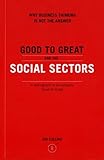 |
author: Jim Collins rating: asin: 0977326403 binding: Paperback list price: CDN$ 14.50 CAD amazon price: CDN$ 11.60 CAD |
Good to Great: Why Some Companies Make the Leap...and Others Don't
Submitted by admin on Tue, 02/05/2008 - 10:50. |
author: Jim Collins rating: asin: 0066620996 binding: Hardcover list price: CDN$ 38.99 CAD amazon price: CDN$ 24.56 CAD |
Five years ago, Jim Collins asked the question, "Can a good company become a great company and if so, how?" In Good to Great Collins, the author of Built to Last, concludes that it is possible, but finds there are no silver bullets. Collins and his team of researchers began their quest by sorting through a list of 1,435 companies, looking for those that made substantial improvements in their performance over time. They finally settled on 11--including Fannie Mae, Gillette, Walgreens, and Wells Fargo--and discovered common traits that challenged many of the conventional notions of corporate success. Making the transition from good to great doesn't require a high-profile CEO, the latest technology, innovative change management, or even a fine-tuned business strategy. At the heart of those rare and truly great companies was a corporate culture that rigorously found and promoted disciplined people to think and act in a disciplined manner. Peppered with dozens of stories and examples from the great and not so great, the book offers a well-reasoned road map to excellence that any organization would do well to consider. Like Built to Last, Good to Great is one of those books that managers and CEOs will be reading and rereading for years to come. --Harry C. Edwards

This web site is licensed under a Creative Commons Attribution License, although certain works referenced herein may be separately licensed.